
Course contents
On this page
IBGDA
Introduction
IBGDA stands for InfiniBand GPUDirect Async, a ground-breaking technique by Mellanox/NVIDIA that allows a GPU thread to directly operate the RDMA NICs to do read/write/signal operations over GPU memory and bypass the host CPU even in the control path. It was originally integrated into the NVSHMEM product to build a global shared memory programming abstraction for GPU programming, but later (Feb 2025) got used in the famous DeepEP library by DeepSeek for efficient expert communication. Since then, IBGDA, as well as the GPU-initiated communication enabled by it, has been going viral because of its great flexibility and high performance in handling irregular non-collective workloads.
For example, in EP, only after the GPU kernel finishes the router computation will you know which token gets dispatched to which set of GPU ranks. This routing information is dynamic and resides in GPU memory, while NCCL requires static on-host input; with IBGDA, you can just let the GPU kernel RDMA write the tokens based on the dynamic on-GPU routing information. This chapter will cover IBGDA’s mechanism, then talk about a variant of IBGDA through a host proxy thread, measure their performance, and briefly talk about EFAGDA from AWS.
IBGDA mechanism
IBGDA moves RDMA posting and completion handling from the CPU into the GPU kernel. Once the kernel knows the destination and data, e.g., from router computation, it can issue communication without handing the request to a CPU thread. Note that NVLink communication can already be done purely in a GPU kernel, while IBGDA makes RDMA communication doable on a GPU as well. NVIDIA’s official IBGDA support is through the open-source GPUNetIO 1. The CPU still sets up the resources, but it makes the queues and doorbell accessible to the GPU:
- Connection setup: The CPU registers memory, creates the QP and CQ, and exchanges connection information with the peer.
- GPU access: GPUNetIO can place the WQ and CQ in GPU memory, register them with the NIC, and map the NIC’s doorbell registers into the GPU address space.
- GPU operation: The kernel gets a
doca_gpu_dev_verbs_qp1 handle. It writes WQEs, publishes them with the required fences, rings the doorbell, and checks completions.
IBGDA operations: GPUNetIO provides put, get, and atomic operations 2, which basically correspond to the CPU-side write, read, and atomic verbs.
GPUNetIO also provides put_signal that combines a data transfer with a notification to the receiver.
This allows a running receiver kernel to know when the incoming payload is ready.
It is basically a put + atomic fetch_add like what we did in the last chapter: write 123 into the peer’s GPU memory, then increment its counter on the same RC QP.
The example below shows how to use GPUNetIO from a GPU kernel.
NVIDIA’s two-process example provides the host connection setup.
Each address object below contains a registered address and key, and the receiver starts with its counter at zero.
// Sender: launch with one GPU thread.
*reinterpret_cast<uint64_t*>(local_payload.addr) = 123;
__threadfence_system();

doca_gpu_dev_verbs_put_signal<
    DOCA_GPUNETIO_VERBS_SIGNAL_OP_ADD,
    DOCA_GPUNETIO_VERBS_RESOURCE_SHARING_MODE_EXCLUSIVE,
    DOCA_GPUNETIO_VERBS_NIC_HANDLER_GPU_SM_DB>(
    qp, remote_payload, local_payload, sizeof(uint64_t),
    remote_counter, atomic_result, uint64_t{1});

doca_gpu_dev_verbs_wait<
DOCA_GPUNETIO_VERBS_RESOURCE_SHARING_MODE_EXCLUSIVE>(qp);atomic_resultholds the old counter value returned byfetch-add.waitconfirms completion of the sender’s operations, but it does not indicate that the receiving kernel has consumed the data.
The receiver must observe the counter and acquire the data before reading the payload. This example relies on the ordered NVIDIA RDMA RC QP:
// Receiver: counter and payload are in this GPU's memory.
while (DOCA_GPUNETIO_VOLATILE(*counter) < 1) {}
doca_gpu_dev_verbs_fence_acquire<DOCA_GPUNETIO_VERBS_SYNC_SCOPE_SYS>();
uint64_t value = *payload; // 123- Visibility: Volatile polling prevents the compiler from reusing an old counter value. It does not replace the acquire fence, which orders the subsequent payload read after observing the signal.
- Buffer reuse: Repeated transfers need a consumption acknowledgment before the sender overwrites data the receiver is still using.
QP sharing: Each QP allocates some QP state in the SRAM of the RDMA NIC ASIC; thus, allocating too many QPs can easily cause an RDMA performance slowdown, as the NIC would need to swap QP state between SRAM and slow host DRAM. Meanwhile, a GPU could have hundreds of thousands of threads. So the practical question becomes how widely to share each QP among different GPU threads while guaranteeing thread safety. To this end, GPUNetIO 3 provides three sharing modes or scopes:
- Exclusive: One thread exclusively uses the QP.
- CTA: Threads within a CUDA block share the QP.
- GPU: Threads across all CUDA blocks share the QP.
Note that sharing QPs avoids allocating one QP per GPU thread, but it also adds contention, as shared QPs need coordination because GPU threads can finish preparing WQEs out of order. Therefore, GPUNetIO 3 also handles two main problems:
- Slot reservation and publication: Threads use atomics to claim WQE slots. Since a later slot may become ready first, the library submits only a contiguous ready range of WQE slots to avoid exposing unfinished work.
- Doorbell updates: A thread can skip a doorbell ringing if another has already submitted its WQEs. Batching can defer ringings, but pending WQEs must be submitted before waiting for completion.
Using more QPs can reduce the contention and fencing costs caused by sharing. For example, one QP per CTA lets threads within each block share while reducing contention across blocks. We will compare these choices in the performance section.
Proxy-based IBGDA
The raw GPU-initiated IBGDA looks like a panacea! No? In practice, when we work on UCCL-EP 4, we find many issues with the raw IBGDA that totally bypasses the CPU in its data path, mostly around performance and transport concerns:
- Performance: Preparing descriptors and ringing doorbells involve dependent scalar operations 4 5 that a GPU handles less efficiently than a CPU.
- Ordering: Many RDMA NICs do not guarantee ordering among verbs like OpenAI MRC and AWS EFA (see our last chapter).
- Congesting: No limits on inflight requests and bytes 4 can easily congest the whole datacenter RDMA network, causing severe performance degradation.
- Portability: IBGDA requires heavy porting efforts 4 6 across different combinations of GPU hardware and NIC hardware across GPU and NIC vendors.
These concerns can be well addressed if we adopt the following proxy-based IBGDA design. We insert a multi-threaded CPU proxy on the control path between GPU and NIC; the GPU still decides what to transfer, but passes the transfer commands to the CPU proxy via an efficient GPU-to-CPU FIFO queue, and the proxy posts the RDMA operation. The CPU proxy lets the GPU initiate communication while moving NIC control work to the CPU:
- Control path: The GPU writes a command into a FIFO in mapped host memory. The CPU proxy reads the peer, buffer offsets, and length, then posts the request to the NIC.
- Data path: The NIC transfers the payload directly between GPU memories through GPUDirect RDMA. The payload does not pass through the CPU.
With the proxy-based IBGDA, we can achieve the following benefits as shown in our UCCL-EP paper 4:
- Proxy-based IBGDA outperforms raw IBGDA with the same number of inflight bytes!
- We can implement software ordering among verbs: using
write-with-immnotifications and sequence tracking to delay a completion signal until the required writes have arrived. - We can implement congestion control and traffic pacing in the proxy to avoid network congestion.
- The GPU-facing interface can stay the same across NVIDIA, AMD, and EFA backends.
Therefore, I think the proxy-based IBGDA as talked about below remains useful even when direct IBGDA is available. Now the question is how to get a very efficient GPU-to-CPU FIFO queue.
Efficient GPU-to-CPU FIFO: The FIFO design determines how much work the GPU and CPU spend exchanging commands. Command size is one factor, but reservation, polling, and credit updates also matter. The formats we discuss are version-specific:
- NCCL GIN proxy: NCCL 2.31.2 7 uses a 128-byte descriptor and defaults to one CPU proxy thread. It also supports multiple proxy threads through
NCCL_GIN_PROXY_NTHREADS. - UCCL-EP proxy: Its FIFO uses 16-byte commands based on MSCCL++ 8. UCCL-EP 6 reduces GPU–CPU traffic by keeping the producer index and cached consumer credits on the GPU. Producers reserve slots with an atomic increment and reload the host’s consumer index 8 only when cached credits run out. The CPU consumes commands in order and releases slots for reuse. A shared producer index can still become a contention point, so UCCL-EP spreads requests across several FIFO channels and CPU proxies.
- KIWI proxy: KIWI 5 9 improves on MSCCL++‘s shared FIFO with one queue per producer and register-cached indices, avoiding shared-index atomics. Our benchmark uses 16-byte commands.
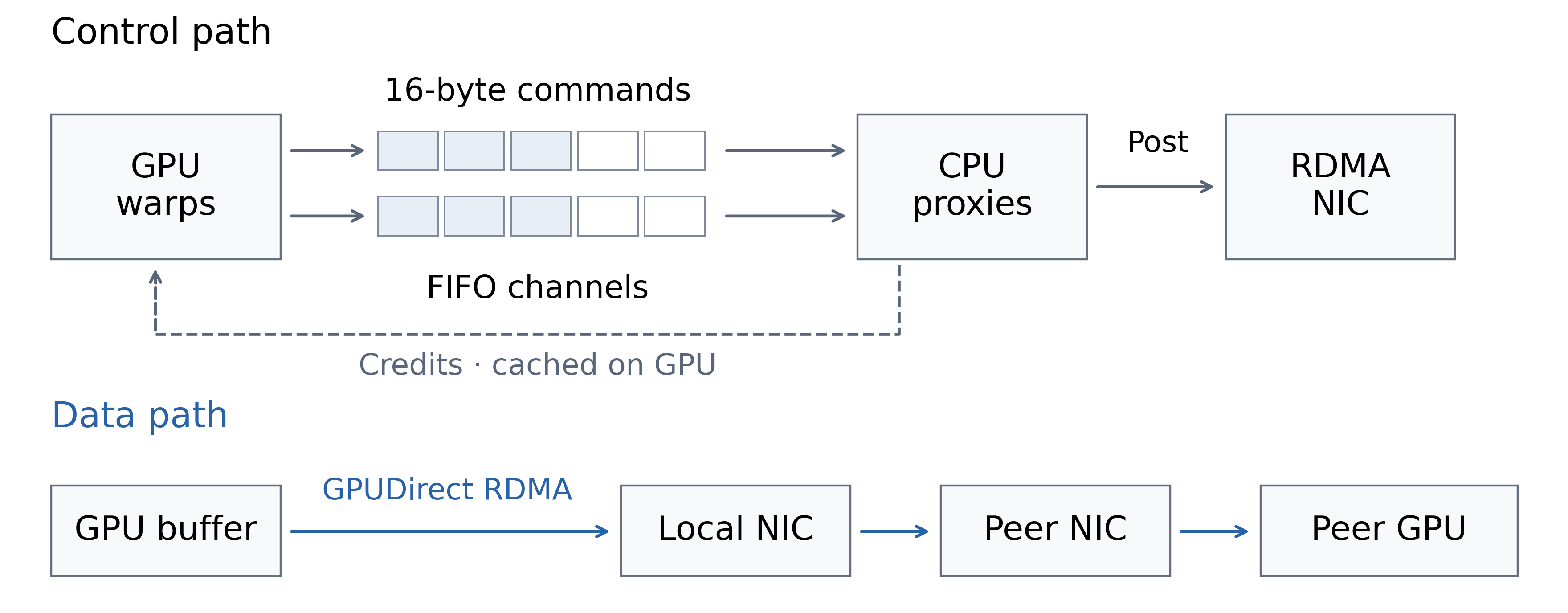
The diagram separates FIFO commands and credits 4 from the RDMA data path, following Figure 6 of the UCCL-EP paper. Releasing a FIFO slot does not necessarily mean the RDMA operation has completed; that depends on the proxy protocol.
Now, let’s benchmark the FIFO performance by measuring how quickly CPU proxies can consume GPU commands. Here we use many producers to keep the proxies supplied and expose their scaling: on a GH200 GPU, 32 SMs each run 32 producer warps, for 1,024 warps total; only lane 0 posts, with 65,536 commands per warp. Each FIFO queue has 1,024 slots. All three designs use one, two, or four CPU proxies. NCCL and UCCL-EP have one FIFO per proxy, while KIWI has one per producer warp.
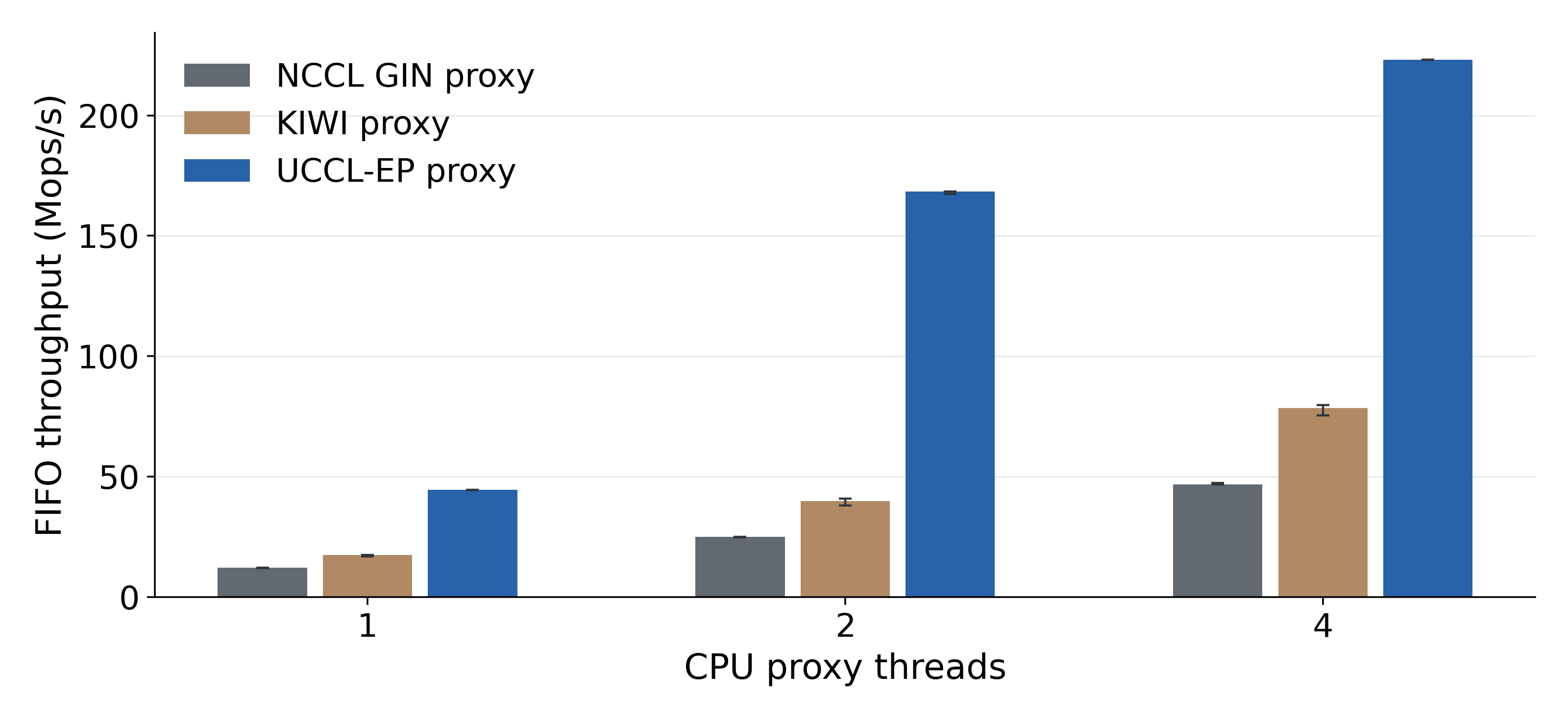
The results show that the UCCL-EP FIFO achieves the highest throughput on GH200; but more importantly, a well-designed FIFO queue can sustain dozens to hundreds of Mops/s, fast enough to sustain the RDMA verb issuing rate in practice. For example, in the DeepSeek V3 EP scenario, 400Gb/s bandwidth with 7KB tokens requires a 7.14 Mops/s verb issuing rate; even if we use an atomic verb for each 7KB token write for notification, it only requires a 14.28 Mops/s verb issuing rate to saturate the line rate. The CSV and benchmark provide the per-run results and validation code.
Practical performance numbers
How does the network performance of IBGDA really perform? It depends on both the command path and how much data is in flight. To answer this, we compare host-driven libibverbs, raw GPUNetIO IBGDA, KIWI proxy IBGDA, and UCCL-EP proxy IBGDA, using one GH200 per host and a 400 Gb/s ConnectX-7 InfiniBand NIC. Both endpoints use GPU buffers; both proxy designs use the same host libibverbs posting and completion code.
Note that GH200’s coherent NVLink-C2C connection makes its GPU–CPU control path different from that of an x86 server with PCIe GPUs. Keep this hardware difference in mind when applying the results elsewhere.
Single-message bandwidth measures the cost of issuing and completing one write at a time. For the GPU-initiated paths, one GPU thread writes a message and waits for completion before issuing the next. Each proxy uses one CPU thread and one RC QP, so message size also equals the number of payload bytes in flight.
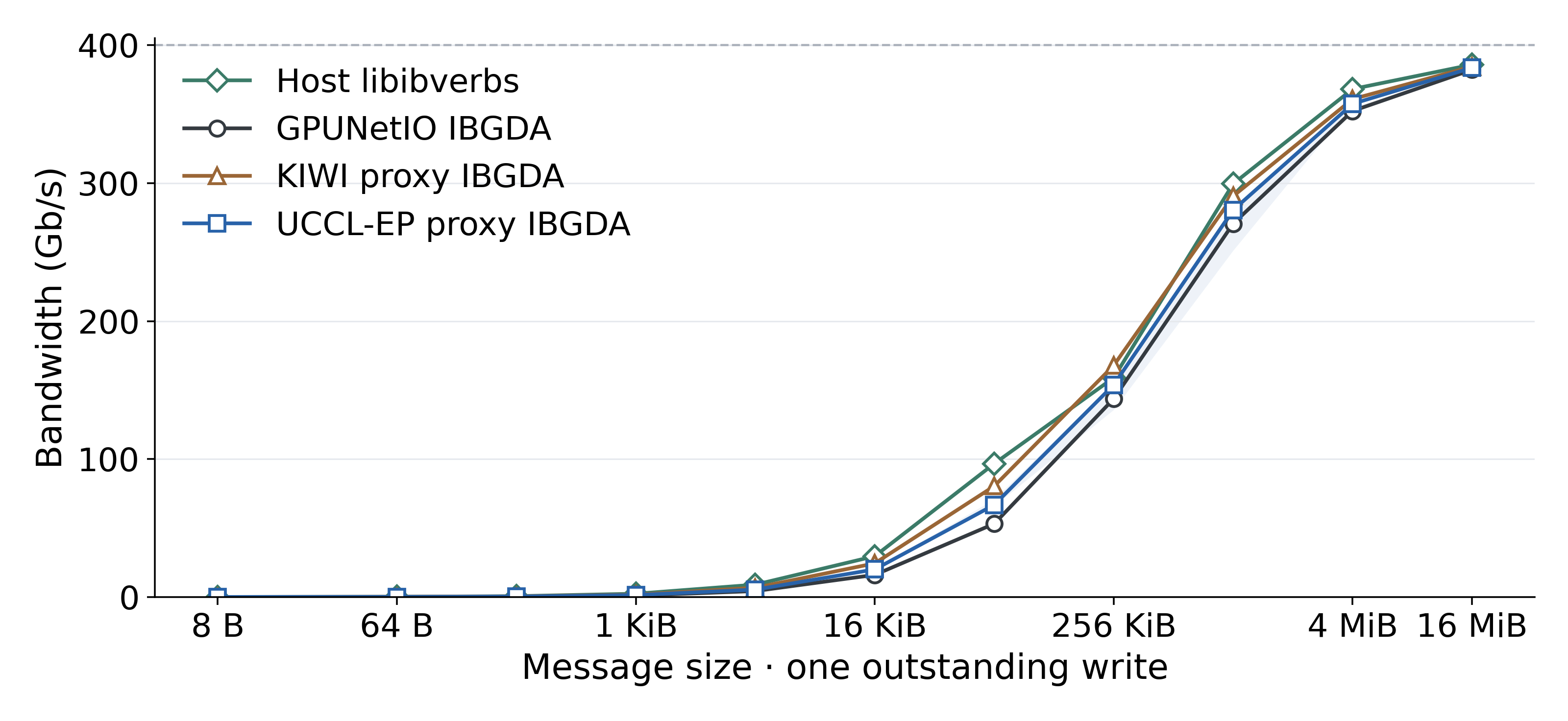
All four paths approach link bandwidth for large messages, while their control costs matter more for small messages. With only one write in flight, each issue-and-completion delay directly limits throughput:
- At 4 KiB: Host libibverbs reaches 8.96 Gb/s, GPUNetIO IBGDA 4.31 Gb/s, KIWI proxy IBGDA 6.72 Gb/s, and UCCL-EP proxy IBGDA 5.35 Gb/s. This is exactly where proxy-based IBGDA actually outperforms the raw IBGDA!
- At 16 MiB: The same paths reach 385.95, 382.27, 384.58, and 383.68 Gb/s, respectively. The transfer takes long enough that control overhead becomes a small part of the total time.
Small-message throughput measures how QP sharing affects the rate of completed eight-byte writes. We increase producer warps from 1 to 256, with only lane 0 posting and up to eight warps per CTA. All direct paths use the same GPUNetIO write primitive and GPU doorbell mode, with different QP-sharing modes.
- GPU mode: All producer warps share one QP.
- CTA mode: Warps within each CTA share a QP. At 256 warps, there are 32 CTAs and 32 QPs.
- Warp (exclusive) mode: Each warp has a dedicated QP, giving 256 QPs at 256 warps. Only lane 0 posts, so this uses exclusive ownership, not cooperative warp execution.
The proxy paths use batching to spread posting and completion costs across writes. Each has four pinned CPU threads and four QPs, with up to 32 writes per ibv_post_send and 256 outstanding writes per QP. The last write in each batch is signaled. QP counts intentionally differ across the curves; this compares configurations rather than equal resource budgets. The CSV and CUDA benchmark contain the measurements and implementation.
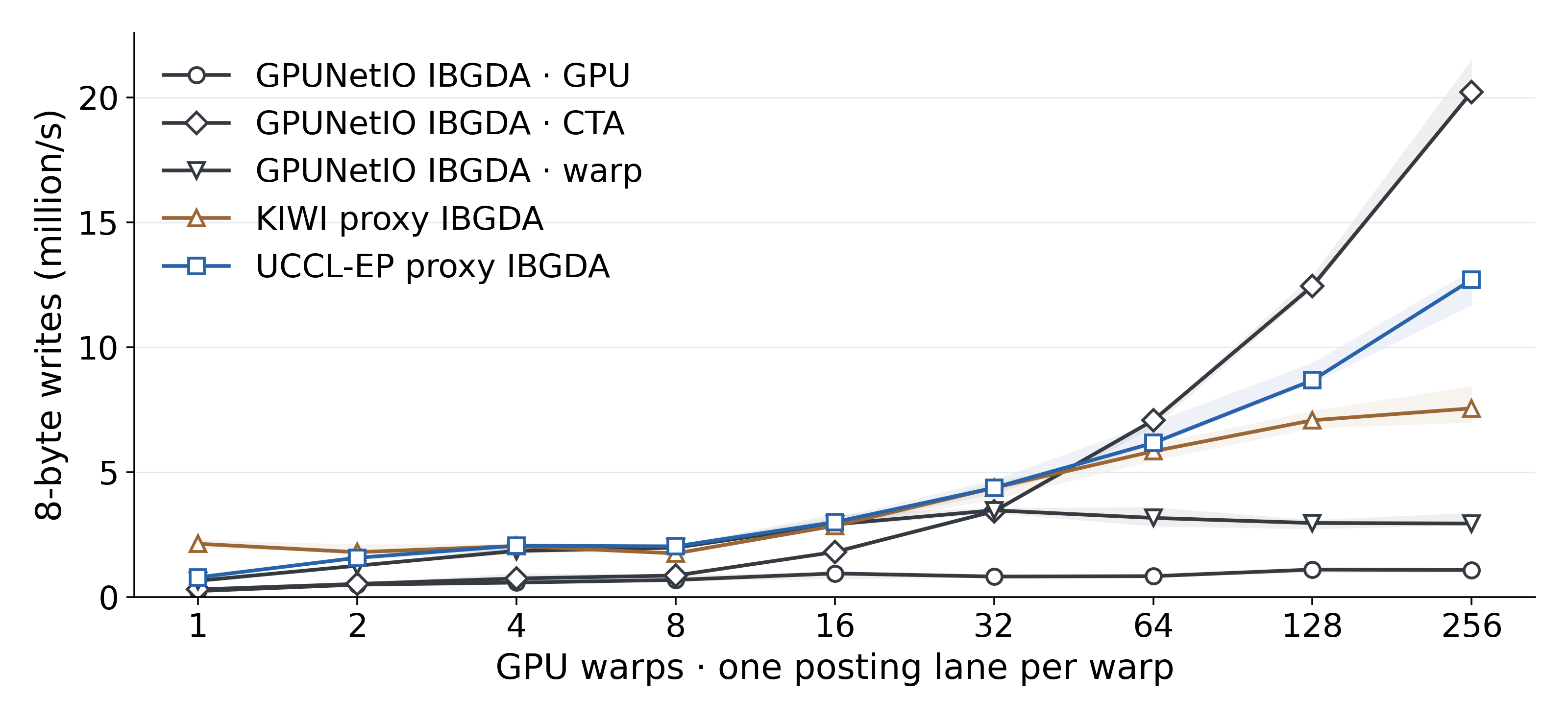
- For GPUNetIO IBGDA, one QP per CTA gives the highest message rate; assigning still more QPs does not improve it.
- At 256 producer warps, GPUNetIO IBGDA GPU mode reaches 1.08 million writes/s, CTA mode 20.22 million, and warp mode 2.94 million.
- At 256 producer warps, KIWI proxy IBGDA reaches 7.56 million writes/s, and UCCL-EP 12.71 million.
EFA-GDA
As mentioned briefly, different combinations of GPU and NIC vendors need their own IBGDA implementations. Here we talk about the EFA-GDA from AWS to implement the IBGDA mechanism for its own EFA NICs and NVIDIA GPUs. EFA-GDA brings GPU-driven communication to AWS EFA using its own NIC interface. GPU-side posting must match the NIC’s queue format, so EFA needs a different implementation from NVIDIA ConnectX IBGDA. The CPU still sets up the resources, after which GPU kernels can post requests directly.
NCCL GIN exposes EFA-GDA through its device communication interface. Applications use registered memory windows, put, local completion counters, and remote signals, while the AWS OFI NCCL plugin handles the EFA backend:
- Enablement:
NCCL_GIN_TYPE=5selects EFA-GDA. It requires supported hardware, drivers, and theefa-directprovider; GPUDirect RDMA alone is insufficient. AWS’s getting-started guide 10 lists the supported configurations. - Host setup:
nccl_ofi_gin_gdaki.cppsets up the plugin, andnccl_ofi_gin_gdaki_resources.cppmaps EFA queues and doorbells through libfabric. - GPU posting: NCCL’s
gin_efa_gda.h11 implements the device path using Amazon’sefa-dp-directlibrary.
EFA’s ordering rules require a different signaling protocol from the ConnectX RC example. The SRD transport in EFA does not provide the same ordering between writes, so a separate signal write could arrive before an earlier payload write. EFA-GDA uses NIC hardware completion counters 12 to tie a signal to a write’s completion:
- Local completion: The sender’s
FI_WRITEcounter tracks local completions. - Remote completion: A signaled payload write advances the destination endpoint’s
FI_REMOTE_WRITEcounter when that write completes. - Standalone signals: A zero-byte write can carry a signal. This is not a native
fetch-addon an arbitrary GPU address; the backend supports indexed signals rather than virtual-address signals. - Weak signals: EFA-GDA so far only supports weak signals 10, so observing a signal guarantees that its attached payload write is visible, but earlier writes may still be in flight.
Remark
IBGDA is a fascinating technique. But to use it stably and across heterogeneous devices, I believe proxy-based IBGDA is the right choice. Another interesting direction is to explore if ASIC-based accelerators like Google TPU and AWS Trainium can achieve a similar technique to speed up EP communication. However, I think the key issue is that the TPU and Trainium software ecosystems are too closed; for example, as far as I know, the Trainium collective communication library is still closed-source to date; this will heavily discourage open-source developers from improving their software ecosystems.
References
Footnotes
-
NVIDIA, GPUNetIO open-source architecture and control/data paths, and GPUNetIO architecture and design. ↩ ↩2
-
NVIDIA, GPUNetIO one-sided device functions and put-with-signal kernel. ↩
-
NVIDIA, QP reservation, publication, and doorbell submission, and GPUNetIO API reference. ↩ ↩2
-
UCCL-EP: Portable Expert-Parallel Communication, §§3.1–3.3 and §6, arXiv:2512.19849. ↩ ↩2 ↩3 ↩4 ↩5 ↩6
-
Jiakun Yan et al., A Fast, Programmable GPU-to-CPU Invocation Layer for GPU-Initiated Communication, §§III–IV and VI, arXiv:2611.23848. ↩ ↩2
-
NVIDIA, NCCL 2.31.2, GIN proxy descriptor layout and device posting path, and proxy-thread configuration. See also the newer short-descriptor path. ↩
-
Microsoft, MSCCL++
215f073f, FIFO device implementation and host FIFO implementation. ↩ ↩2 -
AMD Research, KIWI source and queue-baseline methodology. ↩
-
AWS, GDAKI context resources, and Amazon, EFA direct CUDA data path. ↩
-
NVIDIA/AWS, NCCL EFA-GDA Put, Flush, and signal capabilities and plugin signal capabilities. ↩