
Course contents
On this page
Congestion
Introduction
Managing RDMA network congestion at scale is challenging, especially when handling network congestion and network device failures (both fail-stop and grey failures). These RDMA network congestion issues keep happening and bothering large training jobs 1 2 3 4. I think one of the key reasons is that networking vendors keep the wrong design decisions from the old CPU era, such as single-path congestion control and lossless networks with PFC (priority flow control).
In reality, CPU workloads are fundamentally different from GPU workloads:
- CPU traffic patterns are sporadic, while GPU traffic is bursty in a synchronized way (i.e., all GPUs start RDMA writes at the same time).
- GPU workloads care more about big-message transfer time than small-message latency.
- GPU workloads are very sensitive to 99th-percentile network performance.
I would like to call out that AWS EFA has pioneered bringing a multi-path RDMA transport called SRD 5 to its proprietary EFA RDMA NICs, connecting all its GPUs and Trainium accelerators. OpenAI MRC also applies the multi-pathing idea to commodity RDMA NICs coming from NVIDIA, Broadcom, and AMD. Without further ado, let’s look at why congestion can happen, how multi-pathing can solve it, how to troubleshoot RDMA performance issues in practice, and finally learn a bit about whether the NVLink scale-up domain has congestion.
Why does congestion happen?
Having enough total network bandwidth does not mean every transfer gets its fair share. The previous chapter showed how a fat-tree provides many paths; here, the question is whether traffic actually uses them evenly.
Flow collision: Two large flows can land on the same path while other paths stay idle. Conventional equal-cost multipath routing (ECMP) hashes packet-header fields to choose a next hop, keeping packets of a flow together. With only a few large flows per GPU, those hash choices do not usually balance out. OpenAI 1 and Meta 3 both describe this problem for training traffic: a collision can persist throughout a collective, making the affected GPUs stragglers.
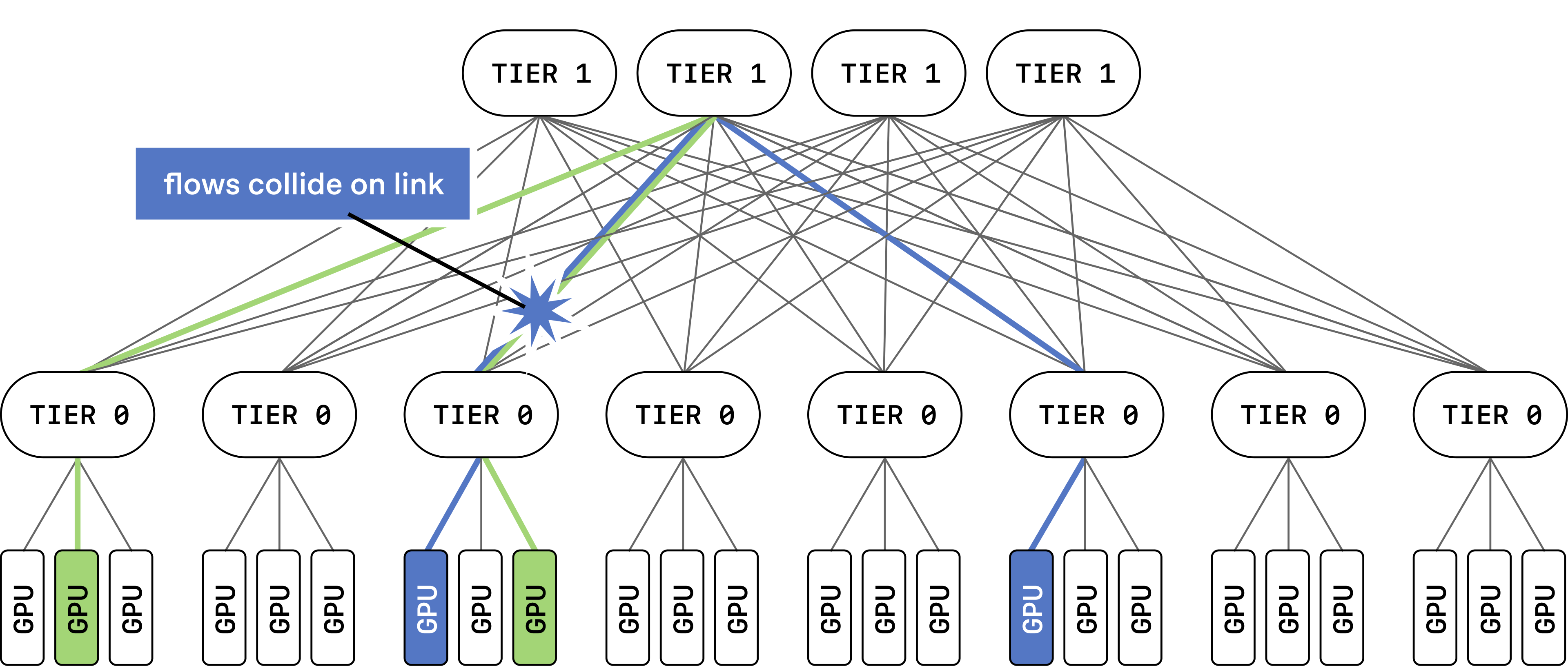
Congestion due to poor load balancing. Figure reproduced from OpenAI’s MRC blog 1, rendered from the original vector artwork.
The shared uplink limits both flows even though their destinations are different. For example, if each sender offers 400 Gb/s, their combined 800 Gb/s cannot fit through that link. Congestion control can make them slow down, but slowing down alone cannot use the idle paths. This is the distinction between controlling the sending rate and choosing a better path.
Several other problems can turn a local bottleneck into a much larger slowdown:
- PFC backpressure: PFC 6 pauses a traffic priority on a switch port, rather than one offending flow. When a congested receiver pauses its upstream switch, that switch’s buffers can fill and trigger further pauses upstream. Unrelated transfers sharing those queues then wait too, causing head-of-line blocking. A stuck NIC can keep this chain alive as a PFC storm, so one malfunctioning endpoint can affect jobs far beyond its own transfers.
- Bad switch or NIC: A device can remain reachable while dropping packets or forwarding too slowly. These grey failures 2 are harder to handle than a clean link-down event: routing may keep selecting the path, while retransmissions delay the whole collective. A transport needs to detect poor paths and move traffic away without waiting for the device to disappear from the routing table.
- Mis-tuned congestion control: A healthy fabric can still perform poorly when senders react too aggressively or too slowly. For example, in the old RDMA congestion control algorithm DCQCN, ECN marking thresholds and rate-adjustment parameters trade off utilization, queue buildup, and recovery speed. Newer congestion control algorithms like HPCC 7 leverage better congestion feedback to help control queues, but they do not by themselves move a flow off a congested path.
- Perhaps a more practical example is that in a public GPU cloud, you will find its RDMA network is usually very congested and you can easily see collective performance drop unexpectedly; this is exactly because the public cloud usually sets very strict congestion control parameters to avoid cross-tenant networking interference, but it turns out that this usually brings down every tenant’s networking performance.
Although it sounds bold, my take is the following:
- Single-path congestion control does not work for GPU networking. In particular, rate control alone cannot fix persistent flow collisions when alternative paths are idle.
- PFC is like a ghost and can unexpectedly degrade random jobs’ performance, especially in the event of hardware failure or malfunction.
Multi-Pathing
Multi-pathing lets one transfer use several routes instead of depending on a single hash choice. The receiver must then handle packets arriving out of order, and the sender must avoid congested or failed paths. AWS-proprietary SRD 5 pioneered this approach in EFA; below are two ways to bring it to a broader range of RDMA NICs.
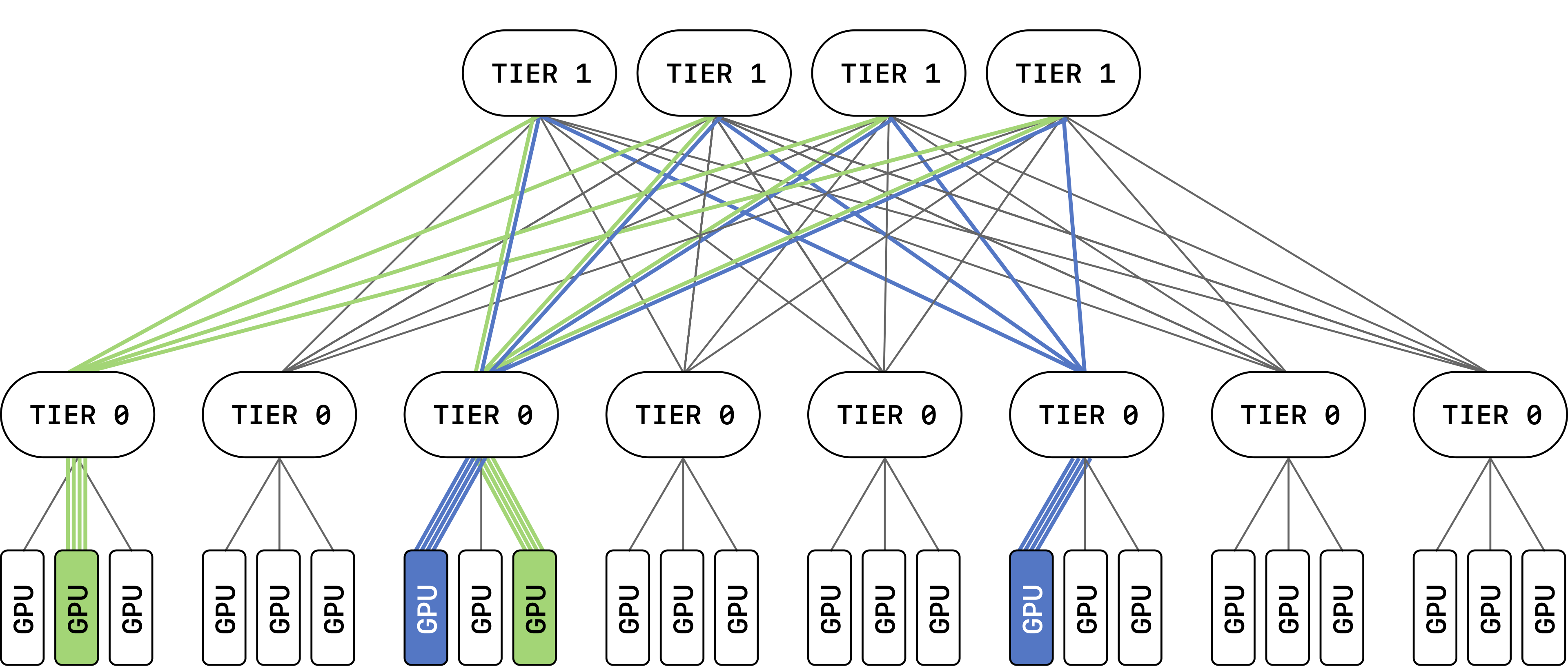
Spraying across many paths equalizes the load. Figure reproduced from OpenAI’s MRC blog 1, rendered from the original vector artwork.
OpenAI MRC: MRC 2 moves packet spraying and recovery into the NIC. Each packet carries enough information to reach its final memory location independently, so the receiver can place it directly even when earlier packets have not arrived. The sender distributes packets across many paths and selectively retransmits missing ones, allowing the network to run without PFC.
MRC also makes path selection respond to congestion and failures. Congested paths are replaced, and paths associated with packet loss are avoided and probed for recovery. OpenAI combines this with static SRv6 source routing 1, allowing the NIC to switch paths without waiting for network-wide route convergence. For more details, see our MRC analysis.
UCCL-Tran: UCCL-Tran 8 implements transport control on the CPU while keeping payload transfers on existing RDMA NICs. On its RC/UC backends, it splits messages into chunks and sends them through multiple QPs; write-with-imm delivers the payload to its destination and exposes control information to the receiver CPU. UCCL-Tran uses per-path RTT to choose less-congested paths and controls the amount of data in flight. This also lets us change recovery and congestion-control policies without redesigning the NIC, including selective retransmission on the UC backend and receiver-driven admission control. See our OSDI paper and UCCL repository for details.
One caveat is that multi-pathing still cannot increase the receiver’s capacity: if many GPUs send to one GPU, every path eventually reaches the same destination NIC and memory path, causing receiver-side congestion. This is the so-called incast. To address it, we need to pace the senders or let the receiver grant sending credits as supported in UCCL-Tran 8, even after balancing traffic inside the fabric.
Troubleshooting
I often hear a joke that most training job failures manifest as a NCCL/network failure, and among these failures, only a small portion can be fully pinpointed; most of the time, people just restart the job and ignore the failure. This joke exactly reflects the grand challenge of troubleshooting RDMA networking issues. Here, I just mention a few suggestions and hope they might help with practical network debugging.
Measurement first: Start by finding which resource is slowing the transfer. Compare a single GPU pair with concurrent pairs, and same-leaf traffic with cross-leaf traffic. A slow isolated pair points us toward link health or the GPU–NIC path; a slowdown that appears only under concurrency points us toward contention. Measure the actual collective too, since good point-to-point bandwidth does not guarantee a fast collective.
For a RoCE NIC, PFC counters 9 help identify where backpressure is coming from. Read them before and after the slow interval, using the Ethernet interface associated with the RDMA port:
ethtool -S <interface>- Received pauses: On
mlx5, increases inrx_prio<p>_pausemean the upstream device is asking this NIC to stop sending on priorityp.rx_prio<p>_pause_durationreports paused time in microseconds, which is more useful than the frame count alone. - Transmitted pauses: Increases in
tx_prio<p>_pausemean this NIC is pushing back on incoming traffic. Check whether the receiver’s PCIe or memory path can drain data fast enough, as discussed in the previous chapter. - Correlating symptoms: Compare pause deltas with port throughput, drops, ECN marks, and link-error counters over the same interval. A pause shows backpressure, but the root cause may be further downstream. These are Ethernet PFC counters; InfiniBand uses credit-based flow control instead.
Tracing the affected traffic: Switch telemetry can identify a problematic flow or queue that aggregate NIC counters hide. Both Broadcom and NVIDIA provide relevant tools, depending on the switch ASIC and installed software:
- Broadcom: BroadView 10 provides buffer-occupancy tracking for microbursts, Flow Tracker for per-flow statistics, and Live-PTI for tracing selected traffic through ECMP or LAG choices. These help check whether flows collide on one uplink while others remain underused.
- NVIDIA: What Just Happened (WJH) 11 records problematic packets and their drop reasons on Spectrum switches. With NetQ, it helps locate affected endpoints and switches; latency and congestion monitoring require Spectrum-2 or later. Use the event timestamps to connect a network event to a slow collective.
Tuning NCCL parameters: Tune the setting related to the observed bottleneck, then rerun the same workload. Start with NCCL_DEBUG=INFO and NCCL_DEBUG_SUBSYS=INIT,NET,GRAPH 12 to inspect the selected transport, NICs, and topology. Three useful groups of knobs are:
- NIC selection:
NCCL_IB_HCAselects RDMA interfaces.NCCL_CROSS_NIC=0favors matching rails across nodes, which helps when crossing rails is expensive. Match these choices to the physical topology. - Path diversity:
NCCL_IB_QPS_PER_CONNECTIONincreases the number of QPs.NCCL_IB_SPLIT_DATA_ON_QPS=1splits each message across them;0rotates messages among QPs. More QPs can improve routing diversity, but can also increase latency and still collide under ECMP. - Transfer granularity:
NCCL_P2P_NET_CHUNKSIZEandNCCL_BUFFSIZE13 affect transfer sizing and buffering. Our debugging experience also includes tuning channel counts and PCIe relaxed ordering. Their benefits depend on the workload and network backend, so copying one cluster’s settings is not a reliable fix.
Use controlled comparisons to separate network problems from local communication problems. For example, temporarily setting NCCL_P2P_DISABLE=1 and NCCL_SHM_DISABLE=1 13 forces local transfers through the network transport for diagnosis; restore them afterward. Our NCCL debugging post walks through this process and many parameter experiments.
NVLink Congestion?
Unfortunately, yes, NVLink can also suffer from both load imbalance and congestion, despite its high bandwidth. For example, measurements on DGX H100 in the paper Scale-up networking research: the next frontier 14 found that physical addresses deterministically map traffic to NVLink lanes, so some access patterns overload a lane while others remain underused. The same study shows that incast can trigger backpressure and slow an unrelated transfer from a participating sender to a different destination. Thus, even a single-tier NVSwitch fabric can exhibit head-of-line blocking. The authors prototype delay-based pacing for copy-engine and SM transfers to reduce this interference.
Communication can also slow computation through shared GPU memory resources, even before NVLink is saturated. The paper Understanding Contention in GPU Scale-Up Domains 15 shows that overlapping copy-engine, SM, and TMA transfers can share bandwidth unevenly, and that NVLink traffic can slow attention kernels through the memory subsystem. This means that making a transfer asynchronous or SM-free does not make it free to overlap. We should measure critical-path kernel and collective latency together, then pace, chunk, or defer background transfers when overlap hurts the overall iteration.
Remark
Network congestion is a challenging problem for LLM workloads. I believe solving it requires a fundamental design shift like those in AWS EFA/SRD, OpenAI MRC, and UCCL-Tran. I also hope that through this DistML course, especially this network congestion chapter, the broader LLM systems community (both industry and academia) can realize the criticality of going multi-path and dropping PFC.
References
Footnotes
-
OpenAI. Supercomputer networking to accelerate large scale AI training. May 5, 2026. https://openai.com/index/mrc-supercomputer-networking/ ↩ ↩2 ↩3 ↩4 ↩5
-
Joao Araujo et al. Resilient AI Supercomputer Networking using MRC and SRv6. https://cdn.openai.com/pdf/resilient-ai-supercomputer-networking-using-mrc-and-srv6.pdf ↩ ↩2 ↩3
-
Adithya Gangidi et al. RDMA over Ethernet for Distributed AI Training at Meta Scale. ACM SIGCOMM 2024. https://engineering.fb.com/wp-content/uploads/2024/08/sigcomm24-final246.pdf ↩ ↩2
-
Kun Qian et al. Alibaba HPN: A Data Center Network for Large Language Model Training. ACM SIGCOMM 2024. https://ennanzhai.github.io/pub/sigcomm24-hpn.pdf ↩
-
AWS HPC Blog. How we enabled uncompressed live video with CDI over EFA. https://aws.amazon.com/blogs/hpc/how-we-enabled-uncompressed-live-video-with-cdi-over-efa/ ↩ ↩2
-
NVIDIA. NVIDIA Onyx, “Priority Flow Control (PFC)” and “PFC Watchdog.” https://networking-docs.nvidia.com/onyxum/3104706lts/priority-flow-control-pfc ↩
-
Yuliang Li et al. HPCC: High Precision Congestion Control. ACM SIGCOMM 2019. https://liyuliang001.github.io/publications/hpcc.pdf ↩
-
Yang Zhou et al. UCCL-Tran: An Extensible Software Transport Layer for GPU Networking. USENIX OSDI 2026. https://www.usenix.org/system/files/osdi26-zhou-yang.pdf ↩ ↩2
-
Linux kernel documentation. Ethtool counters,
mlx5priority port counters. https://docs.kernel.org/networking/device_drivers/ethernet/mellanox/mlx5/counters.html ↩ -
Broadcom. BroadView Analytics, buffer statistics, Flow Tracker, and Live-PTI features. https://www.broadcom.com/products/ethernet-connectivity/software/broadview-analytics ↩
-
NVIDIA. Configure and Monitor What Just Happened, Cumulus NetQ documentation. https://docs.nvidia.com/networking-ethernet-software/cumulus-netq-51/Manage-Events-and-Notifications/Monitor-WJH-Events/ ↩
-
NVIDIA. NCCL Environment Variables. https://docs.nvidia.com/deeplearning/nccl/user-guide/docs/env.html ↩
-
UCCL Team. How to Debug NCCL Performance Issues for ML Workloads? June 30, 2025. https://uccl-project.github.io/posts/debug-nccl/ ↩ ↩2
-
Andrei Stan et al. Scale-up networking research: the next frontier. ACM HotNets 2026. https://djapg7v42ea9q.cloudfront.net/pdf/hotnets26-final29.pdf ↩
-
William X. Zheng et al. Understanding Contention in GPU Scale-Up Domains. ACM HotNets 2026. https://djapg7v42ea9q.cloudfront.net/pdf/hotnets26-final216.pdf ↩